"Appropriation" "discourse" "subversive" "transgressive" "consciousness" "problematic" "examine" "hegemony" "patriachy" "dominant culture" "the other" "postcolonial" "exploitation" "oppression" "ways of knowing" "representations" "objectification" "deviance" "binary" "intersectionality" "activism" "silencing" "hierarchy" "empowering" "internalization" "revitalization" "womyn" "epistemology" "controlling images" "privilege" "normative" "marginalization" "safe space" to name a few.
It's not that I have a problem with any of these words on their own (well, except maybe "womyn"). While I accept that most, if not all, academic departments use their own language, these words and phrases get tossed around so casually among ethnic and gender studies types that I begin to suspect that they're just being used to avoid actual thought. But hey, maybe that's just me.
I kind of want to design a point system that I can use whenever I'm reading a relevant article or book. One point for nouns from the above list. Two points for words ending in "-zation." Three points for anything deemed "problematic." Five points for alternative spellings of "woman," "women," etc.
Any more words you want to add to the list?
Friday, July 3, 2009

Tuesday, June 30, 2009
EVERYBODY WANTS TO BE A HERO.
Some people become firefighters. Others become pilots. And some play Darkon.
As I was browsing the infinitely interesting documentary section of Hulu.com, I came across "Darkon," a cinematic gem about a community of live-action role-players living in a claustrophobic Baltimore suburb. I was captivated, to say the least.
Basically, people who play Darkon create a character who "lives" in the imaginary land of Darkon. Their character joins or creates a kingdom by buying imaginary hexons of "land" using "money" that they somehow "earn" by dressing up in homemade costumes and hitting each other with foam swords every other Sunday. This in-game currency is not to be confused with actual money, which all Darkon players seem to be distinctly lacking; this is actually what makes them, bear with me on this one, extremely endearing.
First, we have the affably tragic Darkon-ites. There's the film's primary subject, whose real name escapes me but who is known in-game as Bannor of Laconia. He's a stay-at-home dad, bitterly excluded from his family's playing card business, and whose friends claim, without ANY embarrassment or irony, that their frat-boy glory days were spent playing Dungeons and Dragons.
There's the teenager who looks and fights exactly like the Youtube Star Wars kid. He uses Darkon as a weight loss program and a social network that will one day bring him the courage he needs to talk to a girl.
There's the Iraq War veteran who states that, after seeing an eight-year-old girl with a bomb strapped to her, he is searching for some meaning in life.
There are also several wonderfully simple young men in the film, the types that you imagine just like beating the crap out of each other with foam swords on the weekends.
And then there's Kenyon Wells, aka Keldar of the Mordomian Empire. I cannot even begin to describe exactly how much, in word, deed, and appearance, Mr. Wells resembles Dwight Schrute from "The Office."

 Spooky, huh?
Kenyon even claims that before Darkon, he was bad at dealing with people, but by playing Keldar, he has risen to a management position in his workplace.
Anyhow, "Keldar" here is pretty much a Darkon bully who generates all the action in the movie. He's the leader of Mordom, an extremely populous, land-hogging, and evil kingdom that is quickly defeating all the other kingdoms and taking over Darkon. We can only assume that he is also the author of the ridiculously infectious Mordom rallying cry: "HAIL MORDOM! Hail Mordom! HAIL MORDOM! Hail Mordom!" You can imagine my surprise when that got stuck in my head.
Bannor of Laconia, the pudgy, lovable stay-at-home dad we mentioned earlier, is worried by how powerful Keldar is becoming and wants to unite the other kingdoms to take him down. He mentions something about Mordom committing war crimes, but basically he wants to be the big man on campus, so he's going after the reigning champion.
Here's Bannor gearing up to kick some foam:

As I was browsing the infinitely interesting documentary section of Hulu.com, I came across "Darkon," a cinematic gem about a community of live-action role-players living in a claustrophobic Baltimore suburb. I was captivated, to say the least.
Basically, people who play Darkon create a character who "lives" in the imaginary land of Darkon. Their character joins or creates a kingdom by buying imaginary hexons of "land" using "money" that they somehow "earn" by dressing up in homemade costumes and hitting each other with foam swords every other Sunday. This in-game currency is not to be confused with actual money, which all Darkon players seem to be distinctly lacking; this is actually what makes them, bear with me on this one, extremely endearing.
First, we have the affably tragic Darkon-ites. There's the film's primary subject, whose real name escapes me but who is known in-game as Bannor of Laconia. He's a stay-at-home dad, bitterly excluded from his family's playing card business, and whose friends claim, without ANY embarrassment or irony, that their frat-boy glory days were spent playing Dungeons and Dragons.
There's the teenager who looks and fights exactly like the Youtube Star Wars kid. He uses Darkon as a weight loss program and a social network that will one day bring him the courage he needs to talk to a girl.
There's the Iraq War veteran who states that, after seeing an eight-year-old girl with a bomb strapped to her, he is searching for some meaning in life.
There are also several wonderfully simple young men in the film, the types that you imagine just like beating the crap out of each other with foam swords on the weekends.
And then there's Kenyon Wells, aka Keldar of the Mordomian Empire. I cannot even begin to describe exactly how much, in word, deed, and appearance, Mr. Wells resembles Dwight Schrute from "The Office."

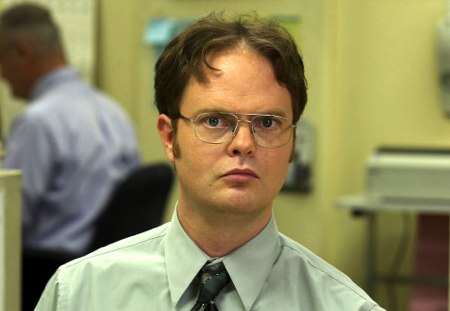 Spooky, huh?
Kenyon even claims that before Darkon, he was bad at dealing with people, but by playing Keldar, he has risen to a management position in his workplace.
Anyhow, "Keldar" here is pretty much a Darkon bully who generates all the action in the movie. He's the leader of Mordom, an extremely populous, land-hogging, and evil kingdom that is quickly defeating all the other kingdoms and taking over Darkon. We can only assume that he is also the author of the ridiculously infectious Mordom rallying cry: "HAIL MORDOM! Hail Mordom! HAIL MORDOM! Hail Mordom!" You can imagine my surprise when that got stuck in my head.
Bannor of Laconia, the pudgy, lovable stay-at-home dad we mentioned earlier, is worried by how powerful Keldar is becoming and wants to unite the other kingdoms to take him down. He mentions something about Mordom committing war crimes, but basically he wants to be the big man on campus, so he's going after the reigning champion.
Here's Bannor gearing up to kick some foam:

It may seem silly to dwell so long on people's in-game characters and story lines, but if you hold that sentiment, you fail to realize just how deep this game actually goes. I can get more correct image search hits for these people by using their in-game names than their real ones, and Mordom, it turns out, has an official logo.
It's weird, it's really weird, but you'll be surprised at how much you wind up liking these guys. They have very distinct personal philosophies and reasons for playing. Bannor sees his quest to defeat the Mordomian Empire as the quintessential American struggle against tyranny and oppression. One of the other rebels, later on, remarks that he feels that Mordom is like the United States, while Laconia and the other kingdoms are like "the terrorists," a comment that draws a truly hilarious sneer from the woman sitting next to him.
But the truly amazing thing about "Darkon," the thing that sneaks up and slaps you across the face, is how down to earth these people actually are. The clarity with which they view themselves approaches self-deprecation at times. In one-on-one interviews, they admit that their lives seem pointless, without direction, without control, and that they use the game to escape those feelings. They are reclaiming their right to matter in a world that doesn't need them to be anything more than drones. From the lathe operator to the fabric buyer, they all feel lost and forgotten in the maze of housing developments and freeways, sweeping vistas of which take on a breathless beauty in the hands of our filmmakers. There is a truly touching moment when "Bannor," going about his mundane husbandly duties, pauses while taking out his trash to look up at a jet plane. The haunting violin score contributes to these themes of alienation and disillusionment.
I recently read an editorial in the New York Times about how to manage feeling out of control in the current economic climate. The writer referred to his grandmother, a Holocaust survivor. For a short period during her time in a concentration camp, she fed a stray cat with her own food. According to psychologists, the writer claims, many Holocaust survivors made it day to day by creating an illusion of control in their lives, be it completely internal or more external, like feeding a cat.
As I watched "Darkon," I couldn't help but think back to this article. LARP sure looks insane, but perhaps it's just another mechanism humans use to simulate control; maybe these mechanisms are the only things that keep any of us sane anymore. So maybe LARP isn't your thing, but maybe you go to movies, maybe you drive fast cars, maybe you have a misleading Myspace page, or maybe you drink all the time.
All that being said, LARP in action looks hilarious and this movie is a ball to watch. Despite how deep its waters run, you'll be laughing for most of "Darkon." In one scene, players attack what appears to be a giant, deranged Sour Patch Kid made of foam, without any explanation whatsoever. In another, a small child engages in a very long epic battle sequence all by himself. The climactic Darkon battle occurs at the Citadel of Peace, which the players must build themselves. You can imagine the scale of the results.
As funny as it is, "Darkon" never feels unfair, exploitative, or voyeuristic. Though it's weird, the people come across very well. Save for a few exceptions, they are incredibly cooperative and respectful of one another. Remember when you were little, and you used to play pretend, and you'd "kill" somebody, but they'd just keep saying "You missed me!" and wouldn't stay down?
Yeah, those kids don't play Darkon.
All in all, "Darkon" is a well-made and engaging documentary about a fascinating, if cringe-inducing subculture. It winds up delving deep into the ways Americans construct selfhood and deal with failure and alienation.
And remember. Never trust an elf.
It's weird, it's really weird, but you'll be surprised at how much you wind up liking these guys. They have very distinct personal philosophies and reasons for playing. Bannor sees his quest to defeat the Mordomian Empire as the quintessential American struggle against tyranny and oppression. One of the other rebels, later on, remarks that he feels that Mordom is like the United States, while Laconia and the other kingdoms are like "the terrorists," a comment that draws a truly hilarious sneer from the woman sitting next to him.
But the truly amazing thing about "Darkon," the thing that sneaks up and slaps you across the face, is how down to earth these people actually are. The clarity with which they view themselves approaches self-deprecation at times. In one-on-one interviews, they admit that their lives seem pointless, without direction, without control, and that they use the game to escape those feelings. They are reclaiming their right to matter in a world that doesn't need them to be anything more than drones. From the lathe operator to the fabric buyer, they all feel lost and forgotten in the maze of housing developments and freeways, sweeping vistas of which take on a breathless beauty in the hands of our filmmakers. There is a truly touching moment when "Bannor," going about his mundane husbandly duties, pauses while taking out his trash to look up at a jet plane. The haunting violin score contributes to these themes of alienation and disillusionment.
I recently read an editorial in the New York Times about how to manage feeling out of control in the current economic climate. The writer referred to his grandmother, a Holocaust survivor. For a short period during her time in a concentration camp, she fed a stray cat with her own food. According to psychologists, the writer claims, many Holocaust survivors made it day to day by creating an illusion of control in their lives, be it completely internal or more external, like feeding a cat.
As I watched "Darkon," I couldn't help but think back to this article. LARP sure looks insane, but perhaps it's just another mechanism humans use to simulate control; maybe these mechanisms are the only things that keep any of us sane anymore. So maybe LARP isn't your thing, but maybe you go to movies, maybe you drive fast cars, maybe you have a misleading Myspace page, or maybe you drink all the time.
All that being said, LARP in action looks hilarious and this movie is a ball to watch. Despite how deep its waters run, you'll be laughing for most of "Darkon." In one scene, players attack what appears to be a giant, deranged Sour Patch Kid made of foam, without any explanation whatsoever. In another, a small child engages in a very long epic battle sequence all by himself. The climactic Darkon battle occurs at the Citadel of Peace, which the players must build themselves. You can imagine the scale of the results.
As funny as it is, "Darkon" never feels unfair, exploitative, or voyeuristic. Though it's weird, the people come across very well. Save for a few exceptions, they are incredibly cooperative and respectful of one another. Remember when you were little, and you used to play pretend, and you'd "kill" somebody, but they'd just keep saying "You missed me!" and wouldn't stay down?
Yeah, those kids don't play Darkon.
All in all, "Darkon" is a well-made and engaging documentary about a fascinating, if cringe-inducing subculture. It winds up delving deep into the ways Americans construct selfhood and deal with failure and alienation.
And remember. Never trust an elf.
Sunday, June 28, 2009
Mariah Carey, "Obsessed"
I was listening to "Every Girl" (Lil Wayne feat. Drake) on the radio not too long ago, and all I could think was how much I want Wayne and all these other decent artists to just ditch the autotune.* It's too easy now to cover up bad singing and rapping, and it sounds more sloppy than interesting after you've heard it the first few times. That said, I do think it is completely possible for autotuning to be applied in ways that can actually make a song sound better. "Obsessed" is one such song.
"Obsessed" is also supposedly a diss song about Eminem. Eminem, whose songs are filled with outdated and not especially clever pop culture references. One of his most recent singles, "We Made You" contains various gags about such current material as "Rock of Love," Kim Kardashian, Jessica Simpson, and Sarah Palin. This appears to be a common trend in Relapse, which apparently also at one point or another takes a poke at Nick Cannon and Mariah Carey, prompting "Obsessed." As one might expect, the insults in "Obsessed" are more bizarre than cutting: "You so so lame," "You a mom and pop/I'm a corporation/I'm a press conference/And you a conversation" and my favorite "Seeing right through you like you're bathing in Windex." It's oddly fitting, that Carey is releasing a diss song directed at Eminem that obsesses over obsession as both stars fade into irrelevance. And for that I do love it.
*Especially Lil Wayne, because he has probably the most recognizable and unique voice in hip hop today. He doesn't need the autotune to sound cool.
Wednesday, June 24, 2009
There are no nice men.
Poor Samson.
 He was just trying to make an honest, non-Irish mob related living. He had a decent blue collar job. He didn't do drugs, beat people up, extort money from old family friends, gamble excessively, steal cars, kidnap Italians, or accidentally kill disabled veterans. He probably didn't live with his parents. In other words, Samson was a normal, mentally stable guy. But Samson, alas, was unlucky in matters of the heart. And much like the Biblical figure he was named after, he fell victim to love.
When Jenny slept with him that one time, little did he know that she'd only done it to make Tommy jealous. When he caught her trying to sneak out on him before he woke up, he was understandably somewhat hurt. When she told him outright that sleeping with him had been a mistake, Samson was clearly disappointed but not angry. He told her that he respected her decision, and said that he would leave the ball in her court. Because Samson was a nice, normal guy and capable of behaving like an adult regarding his relationships. In real life, having recognized that Jenny loved Tommy, Samson would have moved on and probably found a nice, normal girl who would have loved him back.
But this is not real life, this is The Black Donnellys. And the writers just couldn't leave Samson alone because emotionally stable men do not exist in the Donnelly universe. So poor rejected Samson began acting out of character; he became a crazy stalker who hung around Reilly's Diner and alternated between crying and making threats. In the season finale, Jenny beat him to death with a crowbar, but the real Samson had disappeared many episodes ago. He was the victim of character assassination by the very people who created him.
Oh Samson, we hardly knew ye!
 He was just trying to make an honest, non-Irish mob related living. He had a decent blue collar job. He didn't do drugs, beat people up, extort money from old family friends, gamble excessively, steal cars, kidnap Italians, or accidentally kill disabled veterans. He probably didn't live with his parents. In other words, Samson was a normal, mentally stable guy. But Samson, alas, was unlucky in matters of the heart. And much like the Biblical figure he was named after, he fell victim to love.
When Jenny slept with him that one time, little did he know that she'd only done it to make Tommy jealous. When he caught her trying to sneak out on him before he woke up, he was understandably somewhat hurt. When she told him outright that sleeping with him had been a mistake, Samson was clearly disappointed but not angry. He told her that he respected her decision, and said that he would leave the ball in her court. Because Samson was a nice, normal guy and capable of behaving like an adult regarding his relationships. In real life, having recognized that Jenny loved Tommy, Samson would have moved on and probably found a nice, normal girl who would have loved him back.
But this is not real life, this is The Black Donnellys. And the writers just couldn't leave Samson alone because emotionally stable men do not exist in the Donnelly universe. So poor rejected Samson began acting out of character; he became a crazy stalker who hung around Reilly's Diner and alternated between crying and making threats. In the season finale, Jenny beat him to death with a crowbar, but the real Samson had disappeared many episodes ago. He was the victim of character assassination by the very people who created him.
Oh Samson, we hardly knew ye!
Saturday, June 20, 2009
"Bumpits"
A few brief notes about this:
I find something intrinsically laughable about these three hoes just hanging out by the pool with their bikinis and sunglasses and Bumpits, while the commercial confidently assures us that this is a "fabulous" look.
 I'm not sure what the deal is with this woman's hair. Is it damp? Has it been fried? I seriously don't know.
 Huh.
Huh. You, too, can look like this for $19.99!!
 I sort of wish that they would've gone all out and given this girl a straight up Marie Antoinette pompadour. Something to aspire to.
 Yeah, that's all I got.
Friday, June 19, 2009
The missing link?
I started watching Dark Angel, an over-hyped and long defunct sci-fi show starring Jessica Alba. The premise is that in 2000, the government secretly created a bunch of transgenic super soldiers, who later escaped in 2009, the same time that the U.S. economy collapsed due to an event called "the Pulse." The show, which is set in an economically depressed Seattle ten years later, follows the adventures of Jessica Alba's character Max, one of the escaped super soldiers. It's pretty bad. As I was watching, I noticed that the male lead looked awfully familiar. Who is this tool, I wondered. Finally, I realized that this guy...
 is this guy. Gross.
 The similarities are striking. Both NCIS and Dark Angel are (or were, in the latter case) not very good shows that lasted far longer than they should have. Both have inexplicably strong fan bases. And Michael Weatherly had a major (and annoying) role in both, which leads me to wonder if he simply gravitates towards bad shows or if his presence alone is enough to cause a show to turn bad. In other words, could Michael Weatherly be the missing link?
  Max is in Seattle because she's trying to track down her missing super-siblings, and that's where Michael Weatherly's character Logan comes in. Since he's an expert computer hacker, the arrangement is that he finds information about her siblings and she does, er, legwork for him.
 See, because Logan's so good with computers and because he comes from a rich family and therefore doesn't have to work, he occupies his time by taking down corrupt officials and sex slavery rings and the like as "Eyes Only." It's an irritatingly self-righteous venture.
 Max also has a sassy black lesbian friend, Cindy, who is absolutely in no way a stereotype. Nope.
 Cindy decides that Max must be a junkie and flushes her seizure medication. Max breaks into a hospital to try to get more pills but gets caught and sent to jail. Logan informs Cindy about Max's seizures and, after making her feel sufficiently guilty, thinks it would be a great idea to rub it in more: "Even paying off the right people [to get Max out of jail] would take two or three days. She doesn't have that much time...No meds, seizures get bad enough--she could go into a coma and die."

 So far I've watched four Dark Angel episodes, and three of the four involve either Max, Cindy, or both pretending to be hookers at some point. The episode in which nobody got dressed up as a hooker was based on the premise that Max periodically goes into heat because she has cat genes. I really, really wish I was making this up.
 is this guy. Gross.
 The similarities are striking. Both NCIS and Dark Angel are (or were, in the latter case) not very good shows that lasted far longer than they should have. Both have inexplicably strong fan bases. And Michael Weatherly had a major (and annoying) role in both, which leads me to wonder if he simply gravitates towards bad shows or if his presence alone is enough to cause a show to turn bad. In other words, could Michael Weatherly be the missing link?
 Anyway, Dark Angel. Max is a sassy bioengineered super soldier. She has super strength, heals quickly, can run faster than a speeding bullet, etc. However, in the third episode "Flushed," it's revealed that she periodically suffers from seizures due to a tryptophan deficiency (tryptophan is a kind of amino acid that is found in milk). She also has big, poofy lips that are kind of distracting.
 Max is in Seattle because she's trying to track down her missing super-siblings, and that's where Michael Weatherly's character Logan comes in. Since he's an expert computer hacker, the arrangement is that he finds information about her siblings and she does, er, legwork for him.
  See, because Logan's so good with computers and because he comes from a rich family and therefore doesn't have to work, he occupies his time by taking down corrupt officials and sex slavery rings and the like as "Eyes Only." It's an irritatingly self-righteous venture.
Naturally, Logan gets shot in the back in the pilot episode in a staggering display of competence, giving him even more things to whine about. Max sticks around out of guilt and because he's supposed to be her love interest. Though god forbid that they ever actually communicate like adults about those funny feelings they have for each other.
Max works as a bike messenger for this guy, who we're supposed to believe is a real jerk for trying to run his business in an efficient manner. Because it's just not fair that employees should, I don't know, work for their paychecks. The nerve!
 Max also has a sassy black lesbian friend, Cindy, who is absolutely in no way a stereotype. Nope.
  Cindy decides that Max must be a junkie and flushes her seizure medication. Max breaks into a hospital to try to get more pills but gets caught and sent to jail. Logan informs Cindy about Max's seizures and, after making her feel sufficiently guilty, thinks it would be a great idea to rub it in more: "Even paying off the right people [to get Max out of jail] would take two or three days. She doesn't have that much time...No meds, seizures get bad enough--she could go into a coma and die."
What a dick!
The dilemma is solved by smuggling Cindy into prison dressed as a hooker, of course.
 So far I've watched four Dark Angel episodes, and three of the four involve either Max, Cindy, or both pretending to be hookers at some point. The episode in which nobody got dressed up as a hooker was based on the premise that Max periodically goes into heat because she has cat genes. I really, really wish I was making this up.
But I'm not.
Wednesday, June 17, 2009
Hey, let's talk about this guy
KIRK ACEVEDO.
I could probably talk about this man all day. But I'll settle for some highlights, starting with his most famous role as Miguel Alvarez on Oz, back when he was young, frequently shirtless, and smoking.
 There were lots of characters with tragic stories on Oz, but ultimately, Miguel was probably the most tragic of all of them. He got stabbed in the very first episode, and during the first season his infant son died shortly after birth due to all the drugs he and his girlfriend had taken during her pregnancy. Needless to say, Miguel was not very emotionally stable. He resorted to cutting multiple times, and on one occasion he smeared his own shit all over the walls of his cell while in solitary confinemint. His grandfather and father were also prisoners in Oz, and Miguel was clearly trapped in this cycle. Everybody, and I do mean everybody, tried to kill him at one point or another. Yet Miguel made it through all six seasons of Oz, an impressive feat. The show's narrator didn't even survive six seasons! And when he was finally defeated, it was by his own demons; by his impulsiveness, his inability to control his temper, his despair. Miguel wasn't a sociopath, but he was clearly incapable of functioning in normal society. A sad ending for a character who generally meant well but was too deeply invested in the system that destroyed him.
That said, Miguel was great. Check out that swagger, that sneer. He had this lean, muscular look that I find absolutely irresistable, and those big, brown eyes. His fashion sense was pretty awesome as well:
 After Oz, Kirk Acevedo then showed up as Italian mobster Nicky Cottero on the ill-fated yet fabulous The Black Donnellys. Nicky was very different from Miguel in a lot of ways (and not just because he was Italian). For one thing, Nicky wore a lot more leather than Miguel. He never lost control; everything he did was carefully calculated, whether that meant extorting money from Tommy Donnelly or poisoning his pesky mob boss. Not only that, he genuinely seemed to enjoy his job, and he was a real trooper. In one episode he got whacked in the head with a shovel for killing a few Irish he wasn't supposed to kill. Nicky didn't even get knocked unconscious! He just found a way to get even.
 But Nicky did have a few things in common with Miguel, like excellent survival instincts. He also had a great sense of style; he completely renovated Sal Minetta's restaurant to include a snazzy bar and a strip club in back. He also had a special relationship with the strippers; on one occasion he sent his subordinate Vinny out to do surveillance work so he could screw one of the girls for the rest of the episode. Finally, Nicky had more swagger than any of the other characters on The Black Donnellys. I mean, just check out the body language in this picture! Nicky ruled.
 So what is Kirk Acevedo up to nowadays? He has a role in Fringe as Agent Charlie Francis (no, really), ethnicity undetermined. As we can see, he's also adopted a more corporate look, though I do think he needs to wear snappier ties.
  Fringe really, really wants to be a cross between CSI and X-Files, which would be a cool concept if the show itself wasn't kind of dumb. I made it about halfway through one episode; the premise was that some dude created an Internet pop-up in which a glowy hand comes out of the computer and somehow liquifies the brain of the person downloading it (the episode title was "The No-Brainer," har har). Seriously. Agent Francis is mostly involved in the police work on Fringe, not the CSI component. There was this one scene where Agent Dunham comes home to find her niece Ella downloading the file and pulls her away from the screen just as the glowy hand thing emerges. She later describes the incident to Agent Francis: "There were flashes on the computer screen...like bursts of images...and they affected Ella in some way, like she was hypnotized." He gives her this long suffering look...
 ...and then after a pause, says, "I'm going to call Computer Forensics..." and then leaves.
I could probably talk about this man all day. But I'll settle for some highlights, starting with his most famous role as Miguel Alvarez on Oz, back when he was young, frequently shirtless, and smoking.
 There were lots of characters with tragic stories on Oz, but ultimately, Miguel was probably the most tragic of all of them. He got stabbed in the very first episode, and during the first season his infant son died shortly after birth due to all the drugs he and his girlfriend had taken during her pregnancy. Needless to say, Miguel was not very emotionally stable. He resorted to cutting multiple times, and on one occasion he smeared his own shit all over the walls of his cell while in solitary confinemint. His grandfather and father were also prisoners in Oz, and Miguel was clearly trapped in this cycle. Everybody, and I do mean everybody, tried to kill him at one point or another. Yet Miguel made it through all six seasons of Oz, an impressive feat. The show's narrator didn't even survive six seasons! And when he was finally defeated, it was by his own demons; by his impulsiveness, his inability to control his temper, his despair. Miguel wasn't a sociopath, but he was clearly incapable of functioning in normal society. A sad ending for a character who generally meant well but was too deeply invested in the system that destroyed him.
That said, Miguel was great. Check out that swagger, that sneer. He had this lean, muscular look that I find absolutely irresistable, and those big, brown eyes. His fashion sense was pretty awesome as well:
 After Oz, Kirk Acevedo then showed up as Italian mobster Nicky Cottero on the ill-fated yet fabulous The Black Donnellys. Nicky was very different from Miguel in a lot of ways (and not just because he was Italian). For one thing, Nicky wore a lot more leather than Miguel. He never lost control; everything he did was carefully calculated, whether that meant extorting money from Tommy Donnelly or poisoning his pesky mob boss. Not only that, he genuinely seemed to enjoy his job, and he was a real trooper. In one episode he got whacked in the head with a shovel for killing a few Irish he wasn't supposed to kill. Nicky didn't even get knocked unconscious! He just found a way to get even.
 But Nicky did have a few things in common with Miguel, like excellent survival instincts. He also had a great sense of style; he completely renovated Sal Minetta's restaurant to include a snazzy bar and a strip club in back. He also had a special relationship with the strippers; on one occasion he sent his subordinate Vinny out to do surveillance work so he could screw one of the girls for the rest of the episode. Finally, Nicky had more swagger than any of the other characters on The Black Donnellys. I mean, just check out the body language in this picture! Nicky ruled.
  So what is Kirk Acevedo up to nowadays? He has a role in Fringe as Agent Charlie Francis (no, really), ethnicity undetermined. As we can see, he's also adopted a more corporate look, though I do think he needs to wear snappier ties.
  Fringe really, really wants to be a cross between CSI and X-Files, which would be a cool concept if the show itself wasn't kind of dumb. I made it about halfway through one episode; the premise was that some dude created an Internet pop-up in which a glowy hand comes out of the computer and somehow liquifies the brain of the person downloading it (the episode title was "The No-Brainer," har har). Seriously. Agent Francis is mostly involved in the police work on Fringe, not the CSI component. There was this one scene where Agent Dunham comes home to find her niece Ella downloading the file and pulls her away from the screen just as the glowy hand thing emerges. She later describes the incident to Agent Francis: "There were flashes on the computer screen...like bursts of images...and they affected Ella in some way, like she was hypnotized." He gives her this long suffering look...
 ...and then after a pause, says, "I'm going to call Computer Forensics..." and then leaves.
 God, Kirk Acevedo is amazing. And not just because he has the best ass I've ever seen on TV or in real life.
Subscribe to:
Posts (Atom)